
From Spatial Exploration to Transformative Practice
My installation practice is grounded in a post‑material and feminist understanding of space, presence and positionality. Meaning arises through action, relation and the structures that shape how bodies and contexts meet.
What began as spatial exploration developed into a practice where perception, memory and interaction become tools for transformation. Over time, this expanded into a form of activism, not as protest, but as a way of shifting awareness. Today, artistic research and coaching principles converge in installations that create conditions in which perception can change and agency can emerge.
My work has developed from spatial exploration to a practice where presence, memory, and interaction become tools for transformation. What started as questioning perception grew into activism and now into a practice where artistic research and coaching principles meet, creating spaces where awareness can turn into change.

Foundations of Interaction
My artistic practice revolves around the interaction between space, materials, and human experience. Through installation art, I explore themes of identity, borders, power structures, and collective memory, examining how external and internal influences shape perception and lived reality. The installations are part of a broader practice in which painting, performance, video, digital art, and photography continuously inform one another.
The foundation of my installation practice emerged during a student exchange in Berlin. Instead of continuing with conventional lithography, I immersed myself in the Lohmühler Wagenburg, an alternative community on the former Wall zone. Working outdoors and incorporating found materials, I began tracing my surroundings, an intuitive gesture that echoed childhood drawings of outlining ‘my’ house in the sand.
This engagement with the urban landscape and its inhabitants opened conversations about history, memory, and political transformation. It shaped my approach to art, leading to installations that merge physical space with human narratives. My first total installation, Triple Jump (1996), grew from this context, connecting inside and outside through light and sound. The work initiated a series exploring identity within shifting geopolitical frameworks, including reflections on Srebrenica and post‑communist Eastern Europe.
‘Triple Jump’
Total installation, De Nederlandsche Cacaofabriek, Helmond, 1996

In ‘Air’ (2011), I expanded my exploration of spatial interaction by removing physical objects entirely. The work created an immersive environment in which an interior space simulated an exterior one, making the notion of borders perceptible through presence alone.
'Air'
interactive installation/environment, Argument, Tilburg, 2011
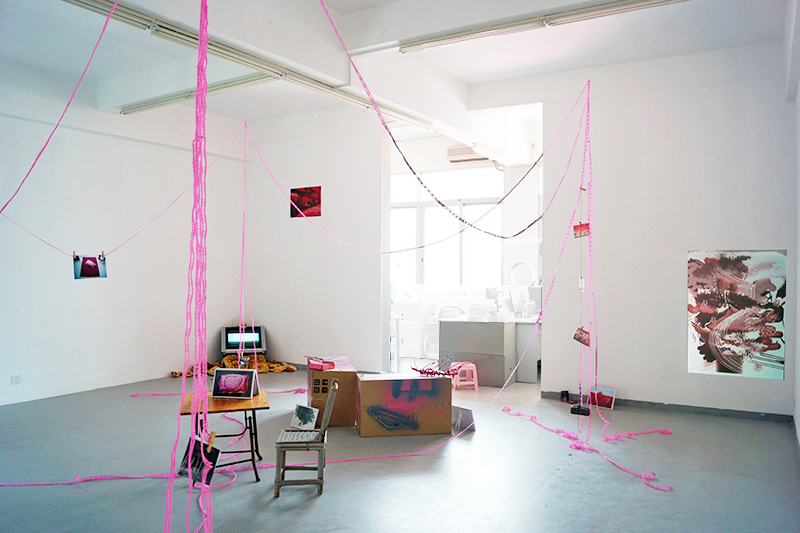
The idea of interconnectedness, without fixed beginnings or endings, continues to guide my practice. During my residency at the Chinese European Art Center (CEAC) in Xiamen in 2014, I developed these ideas further with ’40 Titles’, a total installation later expanded at Cacaofabriek Expo in Helmond (2015).

Connection is a defining element within my installations, which integrate multiple media and site‑specific materials. A key example is the use of pink Chinese clotheslines during the CEAC residency: first drawn through public space, later reconfigured into a cubic structure within the gallery, inspired by Buddhist temple architecture. This shift from one context to another reflects how materials in my practice continually transform in response to their environment.

In ‘Time Table With Memory Holes’ (Artspace Flipside, Eindhoven, 2016), these ideas evolved into a sculptural video installation that extends the dialogue between space, memory, and perception. The work originated from a childhood photograph in which Nazi emblems had been deliberately removed. This act of erasure became the conceptual basis for an animated projection on a perforated table, where shifting patterns obscure direct recognition. Only the light‑defined circular forms remain constant, linking space, time, and perception. Meaning appears and disappears as viewers move around the installation, underscoring the fragility of memory and the ways in which history is continually rewritten

From here, my practice expanded toward a deeper engagement with presence, absence, and the politics of perception, ideas that would become central in the series ‘Position’.
In the series Position, my approach to space, materials, and historical reflection challenges conventional structures of perception. Presence becomes political not through imposed meaning, but through the conditions in which viewers encounter what is visible, absent, or shifting. By creating environments where fragmented histories unfold through movement and interaction, these works position presence as an active force for questioning power, identity, and collective memory.
My installations are often site‑ or event‑specific, shaped by external influences and the spatial or thematic context in which they unfold. They do not exist in isolation; the environment actively contributes to meaning.
A clear example is Position IV, a sculptural installation of red clothing presented over three months in a former Catholic mission chapel, now an art space visible day and night. The chapel’s layered history became part of the viewer’s experience. Because the work was continuously visible, encounters were never uniform; perception shifted with time, context, and perspective. Structured as a series of staged moments, Position IV resisted fixity. Each phase redefined the installation, much like film stills that freeze individual moments while implying movement beyond the frame. The gradual introduction of figures altered both the internal dynamics of the work and its relationship with the chapel allowing the space itself to shape meaning.
'Position' IV
site-specific sculptural art installation, Missiekapel, Heythuysen, 2021

With ‘Maria Was Here’, I introduced direct activism into my practice. Rooted in historical imagery, the sculptural video installation recontextualised Lucas Gassel’s ‘Escape to Egypt’, presenting Maria as a contemporary child bride caught in systemic oppression. The work moved beyond awareness: it generated tangible impact by raising funds for Plan International’s Stop Child Marriages campaign, with €600 donated during its initial presentation at Cacaofabriek Helmond. This marked a turning point in my practice. Interaction, which had previously deepened engagement, now became an active agent for change.
‘Maria Was Here’
sculptural multimedia installation, Cacaofabriek, Helmond, 2020
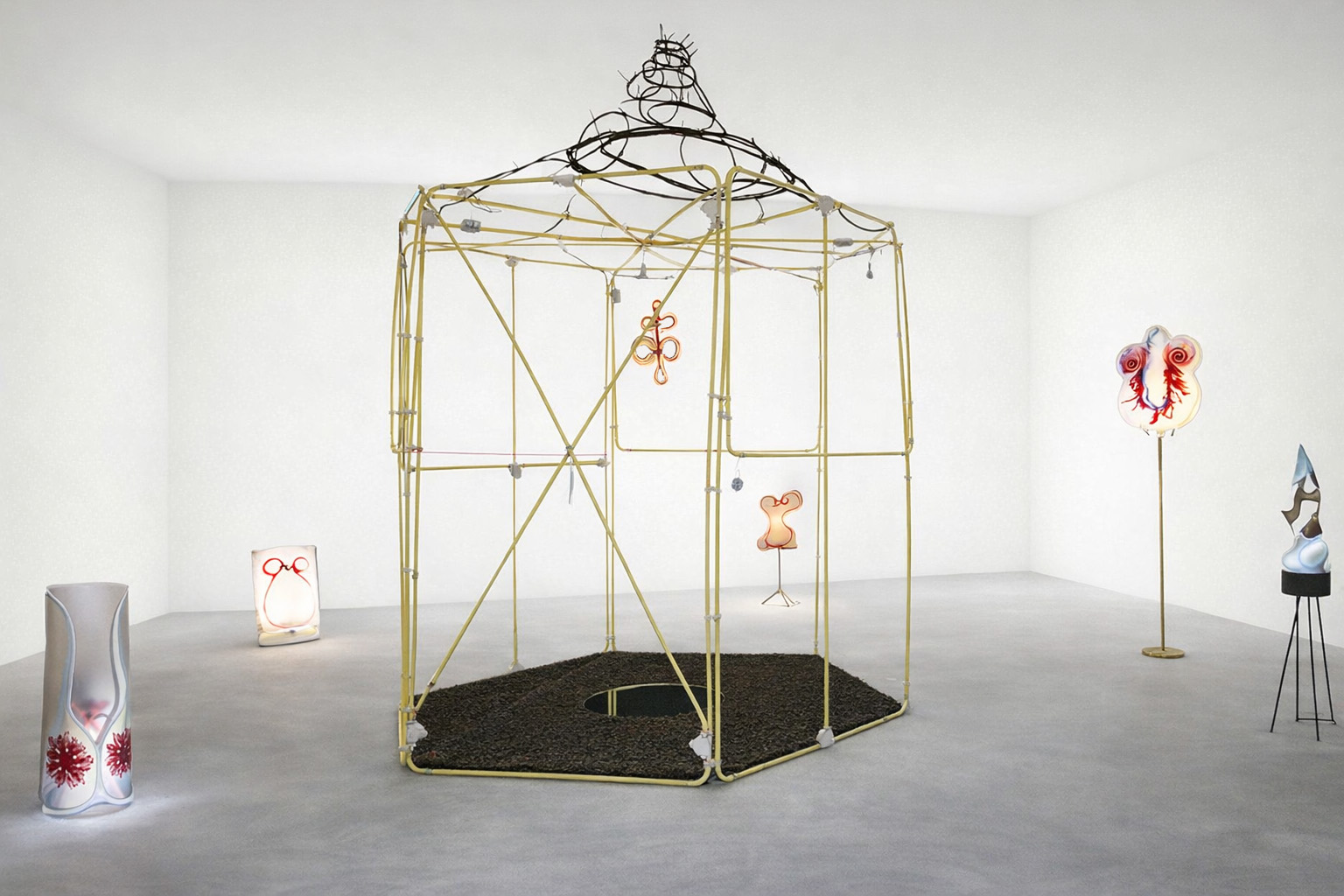
Family Fountain builds on this shift, integrating my artistic practice with my work as a mental coach. The installation invites visitors into a process of inner recognition and empowerment, moving beyond reflection toward active transformation. Emerging from research into the family fountain as a metaphor for the family system, the work offers a space where personal experience, social structures, and embodied presence intersect.
Where earlier installations explored interaction as a way to engage with history or context, ‘Familyy Fountain’ transforms interaction into a tool for empowerment. Visitors participate in a process of recognition, inspection, and exchange, echoing my ongoing interest in site and context, but now directed toward personal development.
As part of the larger Family Fountains project, the installation demonstrates how art can function as both a personal and collective catalyst: not only raising awareness, but supporting real change in how people navigate their inner and relational worlds. This expanded approach marks the current direction of my practice, where artistic environments and mental coaching converge to create spaces for transformation.
Family Fountain
interactive multimedia installation, Big Art, 2024